

How to Build and Grow a ROS Community at Your University?
Tom Cosgrove,
TL;DR: Building a ROS university community starts with a small core team, a shared hardware platform, and a recurring workshop format. You need three things: a reproducible learning path (ROS 2 basics, simulation, real robot deployment), accessible hardware that students can actually break and fix, and project goals tied to research or competitions. This guide explains how to organize a ROS student club, structure ROS 2 workshops, choose teaching materials, and keep momentum across academic years.
Why a ROS University Community Matters
ROS 2 is the de facto standard in mobile robotics research and a growing requirement in industry job postings. Yet most curricula still teach robotics through isolated courses: one semester of kinematics, one of control, one of computer vision, rarely integrated on a real platform. A student-run ROS university community fills that gap. It gives undergraduates and PhD candidates a place to integrate skills on working hardware, share code, and prepare for events like RoboCup, ERC (European Rover Challenge), or the F1TENTH series.
The problem is structural. ROS 2 has a steep learning curve: DDS middleware, the node/topic/service model, tf2, lifecycle nodes, launch files in Python or XML, and the ament build system. A single lecture cannot cover it. A weekly community can, if it is organized correctly.
How to Start a ROS Student Club
You do not need a budget or formal recognition to begin. You need a recurring meeting, two or three motivated people, and a shared repository. The first months should produce visible artifacts: a GitHub organization, a public meeting calendar, and at least one working demo.
Before formalizing the group, work through these foundations:
- Find a faculty sponsor. A professor or lab head gives you access to rooms, networks, and sometimes a small budget. They do not need to attend meetings.
- Define the scope. “Mobile robotics with ROS 2” is workable. “Robotics” is not. Narrow scope keeps early members aligned.
- Pick one hardware platform. Mixing platforms early fragments the group. One robot, one Gazebo world, one set of tutorials.
- Set a meeting cadence. Weekly two-hour sessions work better than monthly four-hour marathons. Skill retention drops fast between sessions.
- Create a public knowledge base. A GitHub wiki or Notion workspace where every workshop leaves notes, code, and a recording link.
Recruitment is easier than most organizers expect. A flyer in the engineering building, a post in the university’s CS Discord, and a 30-minute “what is ROS 2” intro session usually bring in 15-30 students. Retention is the hard part, and retention depends on whether members can run code on a real robot within the first month.
What Hardware Your ROS University Community Needs
Simulation alone does not sustain a community. Students stop attending if they only see Gazebo windows. You need a physical platform that runs the same ROS 2 stack as their simulation, ideally one robot per 4-6 active members so meetings do not bottleneck on hardware.
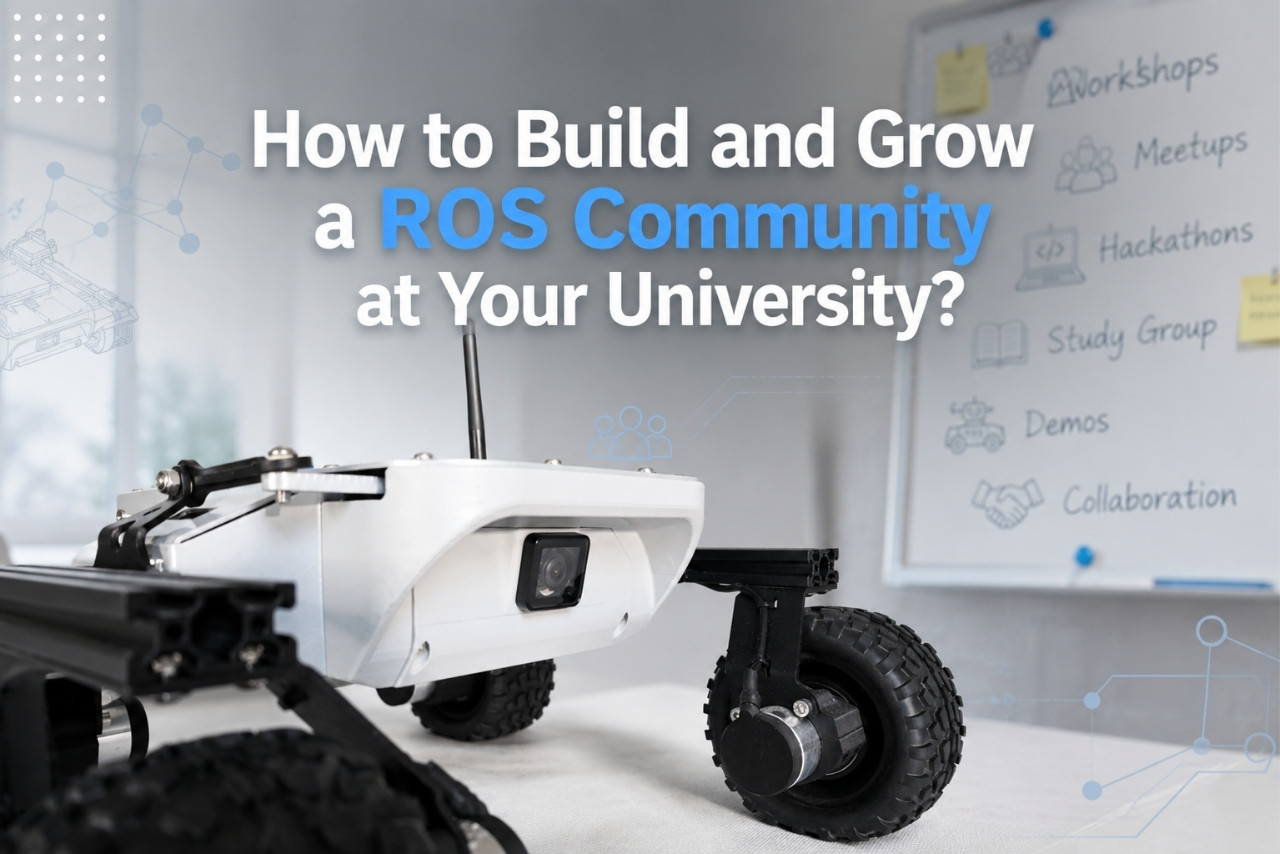
The platform should meet a few practical criteria. It must run ROS 2 natively (Jazzy for new deployments, or Humble where Ubuntu 22.04 compatibility is needed), expose a documented topic interface, tolerate student-grade abuse, and be repairable with parts the group can actually order. The Leo Rover is one option built around these constraints: a 4-wheel skid-steer UGV with a Raspberry Pi-based onboard computer, official ROS 2 packages, and an open mechanical design that lets students modify the chassis without redesigning the whole platform. Other groups use TurtleBot 4, Jackal, or custom builds. The point is not which platform, but that one is chosen and reused.
For outdoor work or field robotics research, the platform also often needs IP-rated electronics and enough payload for a LiDAR, a stereo camera, or an RTK GNSS module. Indoor-only platforms limit the projects you can run, which limits the research connection. Fictionlab documents typical sensor integrations on the research applications page.
How to Structure ROS 2 Workshops
Workshops are the engine of the community. A workshop is not a lecture. It is a 90-120 minute session where every attendee runs code on their own laptop or on a shared robot. The instructor talks for at most 20 minutes total, distributed across the session.
A 10-workshop introductory series that has worked at several universities looks like this:
- ROS 2 setup and the node model. Install Jazzy, or Humble on Ubuntu 22.04, run
turtlesim, inspect topics withros2 topic. - Writing a publisher and subscriber in Python. rclpy basics, message types, QoS profiles at a surface level.
- Launch files and parameters. Python launch syntax, parameter YAML, namespace remapping.
- tf2 and coordinate frames. Static and dynamic transforms, debugging with
tf2_tools. - URDF and robot description. Building a model, visualizing in RViz2.
- Gazebo simulation. Spawning the robot, teleop, sensor plugins.
- SLAM with slam_toolbox or another supported SLAM package. Mapping a simulated and a real environment.
- Nav2 stack. Costmaps, planners, behavior trees at an introductory level.
- Sensor integration. Adding a depth camera or 2D LiDAR, calibrating extrinsics.
- Capstone project. A small autonomous task: navigate to a fiducial marker, follow a person, map a corridor.
Each workshop should end with a working git commit on a shared branch. If a student leaves without running code, the workshop failed. Record sessions when possible; the recordings double as recruitment material and as reference for members who miss a week.
What Teaching Materials to Use
You do not need to write tutorials from scratch. The ROS 2 documentation at docs.ros.org is the canonical reference, and the official tutorials cover the first four workshops above. For Nav2, the Nav2 documentation includes tested examples. For SLAM, slam_toolbox’s GitHub README and documentation are working sources.
What you should write yourself is the integration layer: how these pieces work on your chosen robot, with your sensor configuration, on your network. This is also the most valuable artifact your community produces. A well-maintained “getting started with ROS 2 on [platform]” repository attracts new members, gets cited by other universities, and becomes a portfolio piece for the maintainers.
For education-focused deployments, Fictionlab maintains tutorials and curriculum suggestions on the education applications page, including lab exercises that map to typical robotics syllabi.
How to Sustain the Community Across Years
Student organizations die when the founders graduate. The cause is almost always the same: knowledge lives in people, not in documents. Sustaining a ROS university community requires deliberate handover.
Several practices help long-term continuity:
- Rotate workshop instructors. Second-year members teach first-year members. Teaching forces depth.
- Document hardware state. A wiki page per robot, with serial numbers, known issues, calibration files, and repair history.
- Tie projects to research groups. If a PhD student uses the club’s platform for thesis work, the lab has an incentive to keep the group alive.
- Enter at least one competition per year. A deadline forces integration work that pure learning never does.
- Publish openly. Code on GitHub, demos on YouTube, write-ups on a blog. External visibility recruits new members and attracts sponsors.
The strongest university ROS groups are those embedded in a research lab’s workflow. The weakest are those that exist only as social clubs. The difference is whether the work survives the academic year.
Frequently Asked Questions
How many members does a ROS university community need to be viable?
A core of 4-6 active members is enough to run weekly workshops and maintain one or two robots. Below that, a single illness or exam week stalls everything. Above 20 active members, you need to split into project teams to avoid bottlenecks at the hardware.
Should beginners start with ROS 1 or ROS 2?
ROS 2. ROS 1 Noetic reached end of life in May 2025. Most actively maintained tutorials, packages, and research code now target ROS 2. Teaching ROS 1 in 2025 or later is hard to justify except for legacy systems.
Do you need a faculty advisor to start a ROS club?
Not to start meeting, but you need one to access university funding, lab space, and official recognition. Most universities require a faculty sponsor for any registered student organization.
What is the minimum budget to launch a ROS university community?
Zero, if you start in simulation only. Realistically, one entry-level UGV plus a basic sensor (2D LiDAR or depth camera) lets you run the full workshop curriculum. Many groups fund their first robot through a department grant, a competition prize, or a sponsor.
How long does it take a beginner to become productive in ROS 2?
With a structured weekly workshop, most students can write their own nodes and launch files within 6-8 weeks. Nav2 and SLAM literacy takes another 2-3 months of project work. Becoming a contributor who can debug DDS or write a custom controller plugin typically takes a year of consistent practice.
Can a ROS community work without physical robots?
Partially. Simulation in Gazebo covers most of the learning curve. But retention drops sharply when students never touch hardware. Plan to acquire at least one robot within the first six months.
How do you handle members with different skill levels?
Run two parallel tracks: a beginner workshop following the 10-session curriculum, and a project track where experienced members work on competition or research code. Members move between tracks as they progress. Mixing skill levels in the same workshop slows everyone down.
Start Building Your ROS University Community
A working ROS 2 community at your university starts with one meeting, one repository, and one robot. The curriculum, the hardware integration, and the long-term continuity follow from those three. If you are planning a robotics course, a student club, or a research training program and want to see how a documented platform fits into that workflow, explore Fictionlab’s education applications for curriculum examples, lab exercises, and deployment references used by universities running ROS 2 today.