
Frequently Asked Questions
We know that robotics can be a difficult topic to grasp. To help you, we have collected the most frequent questions we receive here at Fictionlab and provided the answers below.
Custom
Our services include the complete integration of hardware and low-level software. We also design customised user interfaces and dashboards tailored to your system.
We offer various cooperation models in response to customer needs. Each method involves different costs for the customer. Differences may also arise from the division of IP after the project is completed.
By default, yes. The entire IP is transferred upon completion of the project. We are also open to retaining part of the IP in exchange for reduced development costs.
Firstly we talk with the customer to determine the scope of the project. The next step is to validate the idea by creating quick proof of concept robot using our rovers. Finally, based on the feedback, we design fully custom plafrom and provide it to the customer.
It depends. Simple platforms can be created using our Leo or Raph rovers. This can take about 2-3 weeks. Design and manufacturing of the custom robot can take many months, depending on the complexity of the project. We provide more estimates during project scoping and consulations.
Yes, we have our own assembly facility which can handle low-scale manufacturing. To handle higher quantities we can cooperate with the customer to outsource the manufacturing or expand our own facilities.
Yes, we offer assistance to help you obtain the necessary certifications. We will guide you through the process of securing CE or FCC marks for your final robotic solution.
General
Fictionlab is a Polish (European Union) company based in Wrocław. Both production and product development are located there.
If you ever need technical support with our products, join our Discord community - https://discord.com/invite/57DdtCnhCc. There you will gain access to the private support channel with our engineers to help you with your problem. You can also contact us at [email protected].
Yes, all of our products are designed to be modified, and you are encouraged to tinker with it and adjust it for your projects. We support a 'Right to Repair & Hack' philosophy, meaning such modifications do not void your access to support.
No. And we're extremely cautious not to do that in the future. Everything that happens in the Rover is between you and the software. We don't gather any data and connecting the Rover to the Internet is only for your own convenience.
Our products are designed to be modifiable, which negates the purpose of having a CE certificate. If any sensor, for example, were to be added, the certificate would be invalidated.
Leo Rover
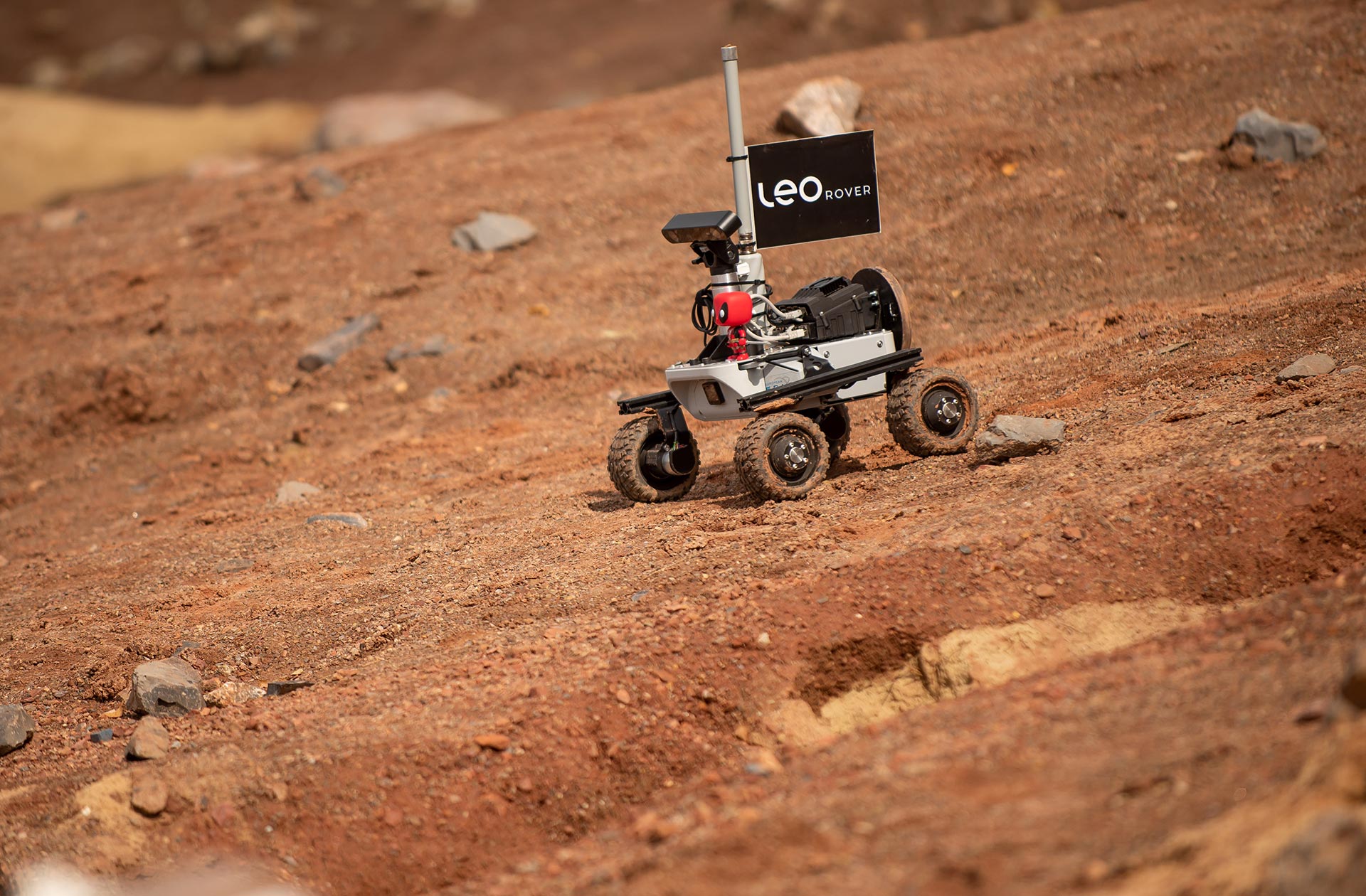
Leo Rover is a compact, four-wheeled robot designed for research, education, and robotic project development. It serves as a reliable mobile platform that allows you to focus on creating sensors and algorithms rather than building a chassis from scratch.
Currently, latest version of the Leo Rover is 1.9.
Main differences are focused around main computer. Leo Rover 1.9 uses newer Raspberry Pi 5 with 4GB of RAM (instead of Raspberry Pi 4B 2GB for Leo 1.8). In addition Raspberry Pi in 1.9 has passive heat sink for better thermal management.
The easiest way is to look at the back of the rover and check if ID plate is present. Leo 1.8 doesn't have it. In addition, Leo Rover 1.9 has antenna on the right side of the chassis. Previous versions had antenna on the left.
Yes, the robot is designed for both indoor and outdoor applications. It features an IP55 protection rating, which makes it resistant to rain and dust, although it is not submersible.
Unfortunately not, but he did take part in a competition that simulates Martian conditions - the European Rover Challenge.
No, but maybe that will change in the future? Who knows. ;)
The maximum payload capacity is approximately 5 kg. There is a mounting plate on the top specifically designed to accommodate various additional devices and accessories.
The standard battery provides a run time of up to 4 hours. The battery system is designed to be easily replaceable, allowing for quick swaps to extend your operating time. Additionally it is possible to buy the High capacity battery that can extend run time up to 10 hours.
The maximum linear speed of the Leo Rover is approximately 0.4 metres per second. It uses four in-hub DC motors with planetary gearboxes to ensure precise movement across different terrains.
The rover is equipped with a built-in Raspberry Pi 5 computer. This is paired with a LeoCore controller based on an STM32 microcontroller to manage low-level tasks like motor control and power distribution.
The system operates on Ubuntu 24.04 and heavily relies on the Robot Operating System, with ROS 2 Jazzy as the standard middleware. For ease of use, it also includes a web user interface that allows you to control the rover directly from a browser.
The Leo Rover 1.9 runs on ROS 2 Jazzy distribution. Previous versions of the Leo (1.8 and below) support also ROS 1 Noetic.
The Developer Kit contains all the parts and tools needed to assemble the Leo Rover. In addition, it also includes a charger for the rover.
Yes, we provide easy, step-by-step instructions how to assemble Leo Rover Developer Kit. The entire process will take approximately 4 hours for someone who knows how to use basic tools (screwdriver, etc.).
The connection range is up to 100 metres. The rover creates its own Wi-Fi access point, but it can also be configured to connect to existing local networks for internet access.
By default Leo Rover comes with front-facing camera, IMU and wheel encoders. If you need more, we provide multiple sensor integrations that you can buy to tailor the rover for your specific project.
Accually yes, but we don't support that officially. Leo Rover can handle higher battery voltages such as 24V. It will increase the speed to about 0.8 m/s but it can reduce lifespan of the motors. Do it at your own risk.
No, it uses skid steering to turn. If you need steering wheels check out our Raph Rover.
Yes, the software for our products is open-source and licensed under the MIT license. Firmware on the other hand is closed-source and not available to modify.
No, our rovers comes with preinstalled web user interface that you can access with your computer or phone. UI can show you basic functionalities of the robots. Coding is only necessary if you wish to extend the functionality of the robots or the UI.
3D printing allows us to quickly improve the design of plastic parts if necessary. In addition, we provide our customers with CAD files so that they can modify parts according to their needs or print replacements if any parts are damaged. The most important structural elements of the rover are made of metal.
Currently, we only offer simulations in Gazebo. We are also considering integrating other simulation options, such as O3DE or Isaac Sim. If you need other simulation engines, let us know on Discord or by email!
We have a multiple addons available such as charging station, powerbox, camera mast, etc. In addition we offer many integrations with sensors such as lidars, GPS, stereo cameras and more. Check our shop for the full list.
Raph Rover
Yes, the software for our products is open-source and licensed under the MIT license. Firmware on the other hand is closed-source and not available to modify.
No, our rovers comes with preinstalled web user interface that you can access with your computer or phone. UI can show you basic functionalities of the robots. Coding is only necessary if you wish to extend the functionality of the robots or the UI.
3D printing allows us to quickly improve the design of plastic parts if necessary. In addition, we provide our customers with CAD files so that they can modify parts according to their needs or print replacements if any parts are damaged. The most important structural elements of the rover are made of metal.
Currently, we only offer simulations in Gazebo. We are also considering integrating other simulation options, such as O3DE or Isaac Sim. If you need other simulation engines, let us know on Discord or by email!
We have a multiple addons available such as charging station, powerbox, camera mast, etc. In addition we offer many integrations with sensors such as lidars, GPS, stereo cameras and more. Check our shop for the full list.
The Raph Rover is an advanced, heavy-duty research and development platform. It is specifically designed to support autonomy projects and carry heavy sensory equipment.
Yes, the Raph Rover is well-equipped for outdoor use. It features an IP54 protection rating and operates reliably in temperatures from -10°C to +40°C.
The Raph Rover has a maximum payload capacity of 10 kg. This allows you to mount a substantial amount of custom hardware or sensors directly to the platform.
A standard charge provides a run time of approximately four hours. However, the rover uses a hot-swappable battery system, allowing for infinite operation if you replace the battery packs on the go.
The robot can reach a maximum linear speed of 1.8 metres per second. Additionally, it has a maximum angular speed of 4.7 radians per second.
The main built-in computer is the UPBoard 7000, which features an Intel N100 processor. It also uses a custom RaphCore controller based on an STM32 microcontroller for lower-level tasks.
The platform operates on Ubuntu 24.04 LTS and uses ROS 2 Jazzy as its core framework. Users can control and monitor the system through a web-based interface accessible over Wi-Fi.
The standard framework installed on the robot is ROS 2 Jazzy. Raph Rover doesn't support ROS 1 as it is already End-of-Life.
Currently, the Raph Rover is not sold as a Developer Kit. It is only available as a fully assembled base unit that is ready to drive out of the box.
The standard connection range for the rover is up to 100 metres. This provides ample distance for remote operation and monitoring.
The stock setup includes a Luxonis stereoscopic camera and an RPLidar S3 2D lidar. It is also equipped with an internal IMU module and wheel encoders.
Yes, the platform features two independent steering wheels located at the rear. This design greatly improves agility and allows for tight manoeuvres, such as rotating around the middle or front wheels.
Shop
The standard shipping time for the rover alone is 5 business days. In the case of integration, this time varies, as we have to work with suppliers of the specific integration. For more information please contact us at [email protected]
We have a multiple addons available such as charging station, powerbox, camera mast, etc. In addition we offer many integrations with sensors such as lidars, GPS, stereo cameras and more. Check our shop for the full list.