Glossary
We know that robotics can be a difficult topic to grasp. To help you, we have collected the most frequent questions we receive here at Fictionlab and provided the answers below.
General
The capability of a robot to plan a path and move through an environment toward a goal without continuous human guidance, using sensor data for obstacle avoidance.
A field of artificial intelligence that enables robots to derive meaningful information from digital images and videos, used for object recognition and visual navigation.
This specific copyright licence allows users to remix, adapt, and build upon a work non-commercially, provided they credit the original creator and license their new creations under identical terms.
A virtual model of a physical robot used for high-fidelity simulations, enabling developers to test software and hardware configurations in a risk-free digital environment.
A collaborative online space where Fictionlab users, engineers, and robotics enthusiasts share knowledge, exchange project ideas, and receive peer-to-peer support.
A comprehensive technical resource hub containing assembly guides, API references, and tutorials necessary for effectively operating and customizing Fictionlab robots.
A worldwide ecosystem of authorized distributors and integrators that provide localized sales, training, and technical assistance for Fictionlab technology.
Inertial Measurement Unit; an electronic device that measures a body's specific force, angular rate, and orientation, crucial for maintaining robot stability and navigation accuracy.
The process of using robotic platforms to monitor infrastructure, detect faults, or collect data in environments that may be hazardous or difficult for humans to access.
Ingress Protection rating; a standard that defines the levels of sealing effectiveness of electrical enclosures against intrusion from foreign bodies (tools, dirt) and moisture.
Legacy Support refers to the continued technical assistance and compatibility measures provided for older hardware versions or superseded software standards.
Light Detection and Ranging; a remote sensing technology that uses laser pulses to measure distances, essential for high-precision 3D mapping and autonomous obstacle detection.
The MIT Licence is a permissive free software licence that grants users unlimited rights to use, copy, modify, merge, publish, distribute, sublicense, and sell copies of the software.
Physical artifacts of technology designed and offered by the open-source community, where CAD files and schematics are available for anyone to study, modify, and distribute.
A group of techniques used to quickly fabricate a scale model of a physical part or assembly using three-dimensional computer-aided design (CAD) data.
A philosophy supported by Fictionlab that empowers users to modify, maintain, and upgrade their robotic platforms without losing technical support.
Robot Operating System; a versatile middleware framework providing a collection of tools and libraries that simplify the task of creating complex and robust robot behavior.
Advanced software environments used to model robotic behavior in a virtual world, essential for developing and debugging autonomous algorithms before field deployment.
Simultaneous Localization and Mapping; a method used by autonomous vehicles to build a map of an unknown environment while simultaneously keeping track of their location within it.
Teleoperation is the technical process of operating a machine or system from a remote location, typically involving real-time video feedback and control commands.
Time-to-deploy is a critical performance metric measuring the duration required to take a robotic project from initial concept to a functional, field-ready state.
Unmanned Ground Vehicle; a mobile machine that operates on the ground without an onboard human, used across various industries for research, mapping, and inspection.
Leo Rover
A four-wheel-drive powertrain configuration where each wheel is independently powered, providing high torque and redundancy for navigating difficult terrain.
Optional hardware components, such as robotic arms or specialized sensor kits, designed to integrate seamlessly with the rover's existing power and data interfaces.
The capability of a robot to plan a path and move through an environment toward a goal without continuous human guidance, using sensor data for obstacle avoidance.
A field of artificial intelligence that enables robots to derive meaningful information from digital images and videos, used for object recognition and visual navigation.
This specific copyright licence allows users to remix, adapt, and build upon a work non-commercially, provided they credit the original creator and license their new creations under identical terms.
A set of professional-grade components provided for self-assembly, designed to give users a deep understanding of the robot's internal mechatronic systems.
Differential Suspension is a mechanical system that allows the wheels on opposite sides of the rover to move vertically relative to one another. This design ensures that all four wheels remain in contact with the ground when traversing uneven obstacles, thereby maximizing traction and stability.
A virtual model of a physical robot used for high-fidelity simulations, enabling developers to test software and hardware configurations in a risk-free digital environment.
FreeRTOS is a real-time operating system kernel for microcontrollers, which runs on the LeoCore and RaphCore control board. It manages the scheduling of critical tasks such as motor control and sensor data acquisition, ensuring deterministic performance for the rover's low-level functions.
Inertial Measurement Unit; an electronic device that measures a body's specific force, angular rate, and orientation, crucial for maintaining robot stability and navigation accuracy.
Ingress Protection rating; a standard that defines the levels of sealing effectiveness of electrical enclosures against intrusion from foreign bodies (tools, dirt) and moisture.
Legacy Support refers to the continued technical assistance and compatibility measures provided for older hardware versions or superseded software standards.
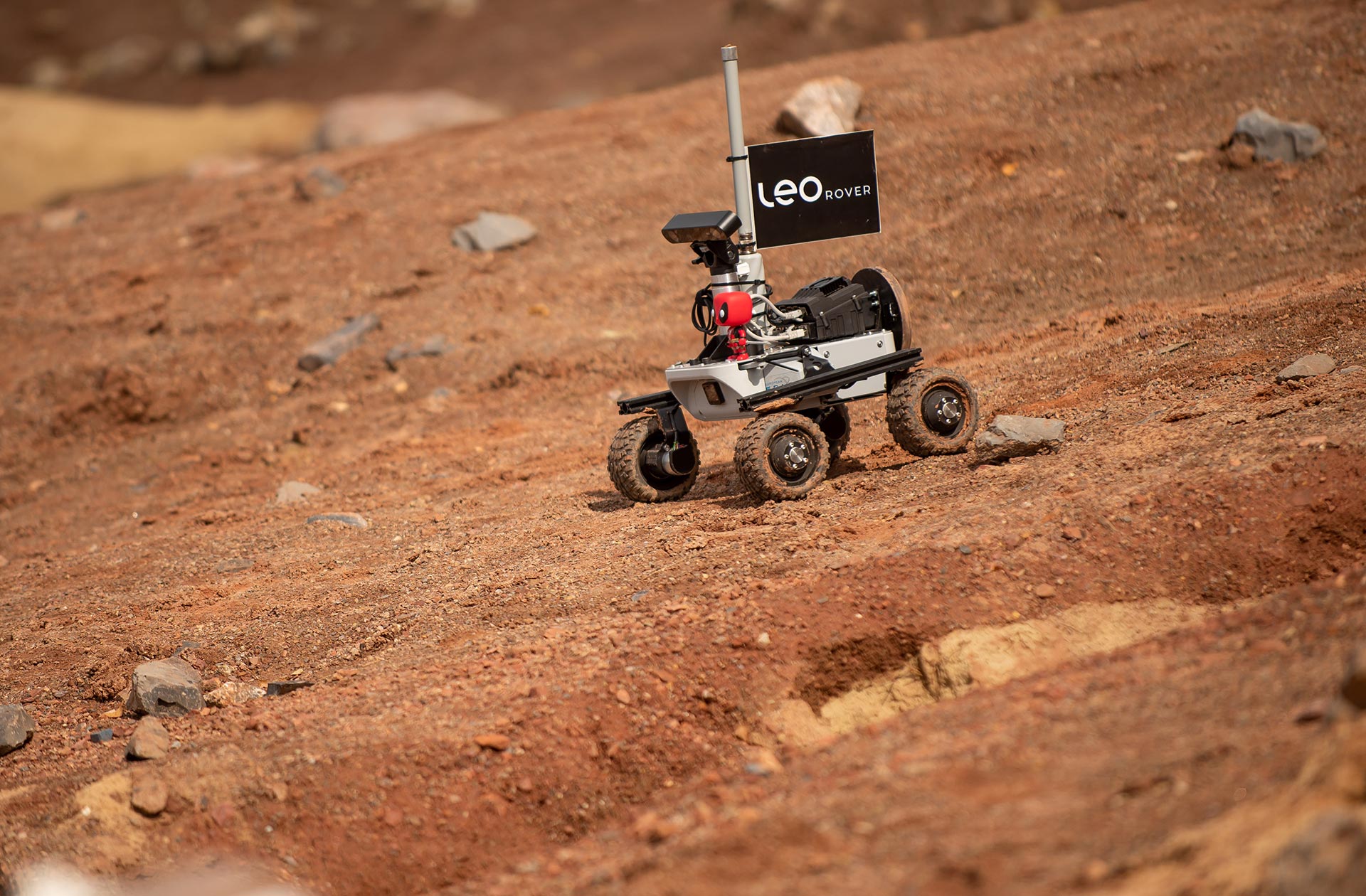
A versatile, outdoor-ready mobile robotics platform designed for research and development, featuring a 4x4 drive system and modular hardware architecture.
A previous version of the Leo Rover platform, still widely used in the community and fully supported with legacy documentation and spare parts.
The latest hardware iteration of the Leo Rover, incorporating refined internal electronics, optimized cable routing, and enhanced mechanical reliability.
LeoCore is the proprietary main control board for the Leo Rover, powered by the STM32F401 microcontroller. It manages real-time tasks such as power distribution, motor control loop execution, and sensor data acquisition, serving as the bridge between the high-level computer and the physical hardware.
LeoOS is a customized operating system distribution based on Ubuntu, specifically optimized for the Leo Rover's hardware architecture. It comes pre-installed with necessary ROS packages, drivers, and network configurations.
Light Detection and Ranging; a remote sensing technology that uses laser pulses to measure distances, essential for high-precision 3D mapping and autonomous obstacle detection.
The MEB, or Main Electronics Box, is the central protective enclosure on the Leo Rover that houses the critical computing and control components. It shields the Raspberry Pi, LeoCore, and associated wiring from environmental hazards.
The MIT Licence is a permissive free software licence that grants users unlimited rights to use, copy, modify, merge, publish, distribute, sublicense, and sell copies of the software.
A standardized mechanical interface on the top of the rover, featuring a grid of holes for the easy attachment of sensors, robotic arms, and custom payloads.
The Powerbox is an add-on module for the Leo Rover that replaces a section of the chassis to provide accessible power interfaces. It offers multiple voltage rails, such as BAT (10-12V) and 5V.
The Rocker-bogie is a suspension system design which connects wheels on each side of the chassis through a pivoting mechanism. It allows vehicle to cross very difficult terrain and obstacles.
Robot Operating System; a versatile middleware framework providing a collection of tools and libraries that simplify the task of creating complex and robust robot behavior.
Advanced software environments used to model robotic behavior in a virtual world, essential for developing and debugging autonomous algorithms before field deployment.
Simultaneous Localization and Mapping; a method used by autonomous vehicles to build a map of an unknown environment while simultaneously keeping track of their location within it.
Teleoperation is the technical process of operating a machine or system from a remote location, typically involving real-time video feedback and control commands.
Unmanned Ground Vehicle; a mobile machine that operates on the ground without an onboard human, used across various industries for research, mapping, and inspection.
Unfinished Machinery is a legal term describing products intended for incorporation into larger systems rather than for direct consumer use.
Raph Rover
A four-wheel-drive powertrain configuration where each wheel is independently powered, providing high torque and redundancy for navigating difficult terrain.
Optional hardware components, such as robotic arms or specialized sensor kits, designed to integrate seamlessly with the rover's existing power and data interfaces.
The capability of a robot to plan a path and move through an environment toward a goal without continuous human guidance, using sensor data for obstacle avoidance.
A Beadlock is a mechanical device that secures the tire bead to the wheel rim using a clamping ring and screws.
A BMS is an electronic system that manages the rechargeable battery packs on the rover. It monitors the state of individual cells, protects against overcharging or deep discharging, and ensures balanced power delivery to maximize battery life and safety.
A field of artificial intelligence that enables robots to derive meaningful information from digital images and videos, used for object recognition and visual navigation.
A virtual model of a physical robot used for high-fidelity simulations, enabling developers to test software and hardware configurations in a risk-free digital environment.
The External Power Panel is an accessible interface on the Raph Rover that provides various voltage outputs for powering auxiliary equipment. It typically includes dedicated ports for 5V, 12V, and direct battery voltage, enabling seamless integration of user payloads.
FreeRTOS is a real-time operating system kernel for microcontrollers, which runs on the LeoCore and RaphCore control board. It manages the scheduling of critical tasks such as motor control and sensor data acquisition, ensuring deterministic performance for the rover's low-level functions.
Hot-swappable Batteries are power packs that can be removed and replaced without shutting down the rover's systems.
Inertial Measurement Unit; an electronic device that measures a body's specific force, angular rate, and orientation, crucial for maintaining robot stability and navigation accuracy.
The process of using robotic platforms to monitor infrastructure, detect faults, or collect data in environments that may be hazardous or difficult for humans to access.
The Intel N100 is a power-efficient x86 processor used in the Raph Rover's onboard computer, the UPBoard 7000.
Ingress Protection rating; a standard that defines the levels of sealing effectiveness of electrical enclosures against intrusion from foreign bodies (tools, dirt) and moisture.
Light Detection and Ranging; a remote sensing technology that uses laser pulses to measure distances, essential for high-precision 3D mapping and autonomous obstacle detection.
The maximum operational weight of external equipment that the Raph Rover can carry while maintaining its full range of motion and performance standards.
A heavy-duty mobile robot platform engineered for professional and industrial field applications, offering increased stability and mission-specific payload capabilities.
RaphCore is the custom-designed main control unit for the Raph Rover, powered by the STM32H563 microcontroller. It orchestrates complex drivetrain mechanics, including the steering rear axle and BLDC motor synchronization, while managing power distribution.
Robot Operating System; a versatile middleware framework providing a collection of tools and libraries that simplify the task of creating complex and robust robot behavior.
Advanced software environments used to model robotic behavior in a virtual world, essential for developing and debugging autonomous algorithms before field deployment.
Simultaneous Localization and Mapping; a method used by autonomous vehicles to build a map of an unknown environment while simultaneously keeping track of their location within it.
The Steering Rear Axle is a mechanical system on the Raph Rover where the rear wheels pivot to direct the vehicle's motion. This configuration reduces the turning radius and tire scrubbing associated with skid-steer systems, improving odometry accuracy.
A Stereoscopic Camera is an imaging device with two or more lenses that simulates human binocular vision to perceive depth.
Teleoperation is the technical process of operating a machine or system from a remote location, typically involving real-time video feedback and control commands.
Unmanned Ground Vehicle; a mobile machine that operates on the ground without an onboard human, used across various industries for research, mapping, and inspection.
Unfinished Machinery is a legal term describing products intended for incorporation into larger systems rather than for direct consumer use.
Robot House
An Anti-collision System is a safety feature, often comprising LiDAR or vision sensors and software algorithms, designed to prevent robots from impacting obstacles or other agents.
A full-cycle development process offered by Robot House, covering R&D, prototyping, testing, and final manufacturing of custom robotic systems.
This specific copyright licence allows users to remix, adapt, and build upon a work non-commercially, provided they credit the original creator and license their new creations under identical terms.
The specialized design and fabrication of printed circuit boards (PCBs) and power systems tailored to the unique requirements of a specific robotic mission.
Custom Robotics Services encompass the bespoke engineering and integration work provided by Fictionlab's Robot House division. This includes modifying standard platforms, developing proprietary payloads, and writing custom software stacks to meet the unique requirements of industrial or research clients.
A Dedicated Solution is a robotic system engineered from the ground up or significantly modified to address a single, specific use case. Unlike general-purpose platforms, these solutions are optimized for a particular task, such as pipe inspection or agricultural monitoring, often involving custom chassis designs.
A group of techniques used to quickly fabricate a scale model of a physical part or assembly using three-dimensional computer-aided design (CAD) data.
Fictionlab's specialized division providing bespoke engineering services, from initial conceptual design to the delivery of market-ready robotic solutions.
Time-to-deploy is a critical performance metric measuring the duration required to take a robotic project from initial concept to a functional, field-ready state.
Unfinished Machinery is a legal term describing products intended for incorporation into larger systems rather than for direct consumer use.
Shop
Optional hardware components, such as robotic arms or specialized sensor kits, designed to integrate seamlessly with the rover's existing power and data interfaces.
A set of professional-grade components provided for self-assembly, designed to give users a deep understanding of the robot's internal mechatronic systems.
A collaborative online space where Fictionlab users, engineers, and robotics enthusiasts share knowledge, exchange project ideas, and receive peer-to-peer support.
A Distributor is a third-party commercial partner authorized to sell Fictionlab products in specific geographic regions.
A comprehensive technical resource hub containing assembly guides, API references, and tutorials necessary for effectively operating and customizing Fictionlab robots.
A worldwide ecosystem of authorized distributors and integrators that provide localized sales, training, and technical assistance for Fictionlab technology.
The predicted amount of time between the initiation of an order and the completion of the delivery process for Fictionlab products.
Lead Time is the duration between the placement of an order and the shipment of the product from the warehouse.
A standardized mechanical interface on the top of the rover, featuring a grid of holes for the easy attachment of sensors, robotic arms, and custom payloads.
The maximum operational weight of external equipment that the Raph Rover can carry while maintaining its full range of motion and performance standards.