

From PhD Research to Real Deployment: How Academic Robotics Projects Scale Up
Tom Cosgrove,
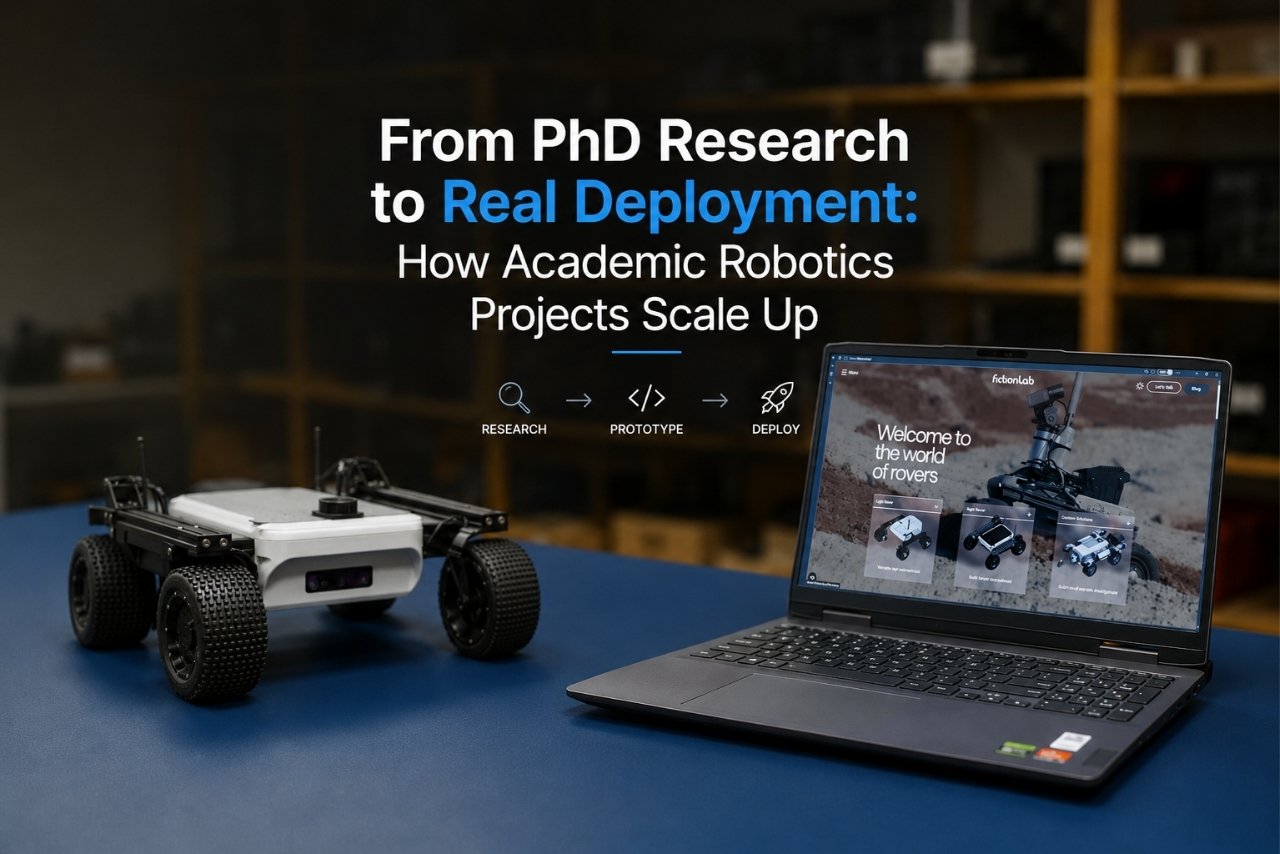
TL;DR: Scaling academic robotics from a PhD prototype to a deployable product is mostly about closing the gap between TRL 4 and TRL 7 – the messy middle where a working demo meets dust, rain, repeatable assembly, and users who do not read the README. In this article we walk through how we at Fictionlab see research robots mature into field-ready platforms, what breaks first, and how teams using Leo Rover and Raph Rover compress that journey by reusing a hardened ROS 2 base instead of rebuilding the wheel, the motor controller, and the power board every time.
Why academic robotics to product transitions stall in the lab
Most robotics PhDs end with a video, a paper, and a robot that works once, on a specific Tuesday, in a specific corridor, with a specific battery charge level. That is fine – the academic deliverable is knowledge, not a product. The trouble starts when an industrial partner, a spin-off founder, or a follow-up grant asks the obvious question: “can we deploy ten of these in the field next year?”
The honest answer is usually “not without rebuilding 70% of it.” The academic robotics to product path stalls because the lab prototype optimizes for novelty (a new SLAM front-end, a new planner, a new manipulation policy), while a deployable system optimizes for boring things: ingress protection, connector strain relief, firmware update flow, calibration repeatability, and the ability for a non-author to swap a wheel motor in under twenty minutes.
This is the classic Technology Readiness Level (TRL) trap. The NASA-derived TRL scale, also adopted by the European Commission for Horizon programs, puts a working lab demo around TRL 4-5. Field-ready hardware sits at TRL 7-8. Between them is what we informally call the “valley of integration” – the part nobody writes papers about.
What actually changes between TRL 4 and TRL 7 in mobile robotics
When we talk to research groups bringing their work onto a Leo Rover or a custom platform, the same categories of work come up again and again. The novel algorithm is rarely the bottleneck. The bottleneck is everything around it.
Here is what typically needs to be rebuilt or hardened on the road from prototype to product:
- Power architecture – lab robots often run on a bench supply or a single LiPo with no BMS. Field units need protected packs, hot-swap or safe shutdown, and brownout-tolerant compute.
- Mechanical tolerances – 3D-printed brackets that survived a demo will not survive 200 hours of vibration on gravel. Aluminum, proper fasteners, and thread-locker enter the picture.
- Sensor mounting and calibration – a camera zip-tied to a frame is not a sensor rig. Repeatable extrinsics across a production batch is its own engineering problem.
- Software lifecycle – ROS 2 nodes that run from a terminal need to become systemd services with logging, watchdogs, and remote update.
- Documentation for someone else – if only the original PhD student can boot the robot, it is not a product, it is a souvenir.
The ROS 2 maturity question
ROS 2 helps a lot here, but it is not a magic wand. Moving from ROS 1 demos to ROS 2 production code forces teams to confront DDS configuration, QoS profiles, and lifecycle nodes – things that were easy to ignore on a single-machine lab setup. We have seen teams discover at deployment time that their multicast-based discovery does not survive the customer’s VLAN. That is a TRL 6 lesson learned the hard way.
The upside: ROS 2’s emphasis on real-time behavior, security (SROS2), and managed node lifecycles is exactly what a field deployment needs. The work is real, but it pays back.
How a hardened base platform shortens the academic robotics to product path
This is where we get opinionated, and it is the reason Fictionlab exists in its current form. The Leo Rover started as an internal project and grew into an open-source platform precisely because we kept watching research teams reinvent the same chassis, the same motor driver integration, the same Wi-Fi access point setup, the same ROS bringup. Every group paid the same tax.
A reusable base platform does not solve the research problem. It solves the plumbing problem, so the research problem is the only thing left to work on. Concretely, when a team builds on top of a mature UGV, the following items are already at roughly TRL 7:
- Drivetrain, motor control, and odometry – tested across thousands of hours by other users.
- Power distribution and charging – with documented safe operating limits.
- A ROS 2 bringup that actually launches on boot, every time.
- A mechanical mounting pattern that does not require a machine shop to extend.
- A community of users who have already hit the obvious bugs and reported them.
The research payload – a new perception stack, a manipulator, a novel planner – is grafted onto a known-good base. The team’s TRL effort is concentrated where the novelty lives, not spread thin across the whole stack. This is the same logic as not writing your own operating system to publish a web app.
Where custom work still makes sense
Not every project fits a standard rover. When the science requires a non-standard form factor, payload, or environmental rating (think IP67, ATEX-regulated dust environments, or unusual climbing geometry), starting from a platform like Raph Rover or commissioning a custom robotics build is often faster than retrofitting a consumer-grade base. The decision usually comes down to whether the research depends on the chassis being unusual, or only on the payload being unusual.
What we learned watching research projects deploy: three patterns
Across the field robotics projects we have supported through the research applications path, a few recurring patterns shape whether the academic robotics to product transition succeeds or stalls.
Pattern 1: The “one more paper” trap
Teams keep adding research features instead of freezing scope and hardening what exists. Every new feature resets the integration clock. The fix is brutal but effective: declare a feature freeze, define a deployment date, and treat anything not on the list as a future version.
Pattern 2: Underestimating the field environment
A robot tested in a clean robotics hall behaves differently in a vineyard, a quarry, or a hospital corridor with reflective floors. Dust changes optical flow. Rain changes LiDAR returns. Fluorescent and LED lights can flicker at frequencies that confuse rolling shutter cameras. We tell teams to budget at least one full field trip before they think they are ready, because the list of surprises is always longer than expected.
Pattern 3: No plan for the second unit
The first robot is built lovingly by the people who designed it. The second robot reveals which steps were undocumented tribal knowledge. Teams that plan from day one for a “build instruction” rather than a “build” tend to scale; teams that do not, end up with a fleet of subtly different robots that each need their own bug fixes.
How to structure a project that has to leave the lab
For groups starting a PhD or a funded research project today with the intent of eventual deployment, a few structural choices pay off massively later. We have seen this on Leo Rover deployments in agriculture, inspection, and education, and the pattern holds.
The practices that consistently help include:
- Use ROS 2 from the start, not ROS 1 with a “we will port later” plan. The port is never cheap.
- Pick a base platform early and commit. Switching chassis at month 18 is a six-month setback.
- Version your hardware like your software. Every robot gets a build sheet, a serial number, and a changelog.
- Automate the bringup. If launching the robot requires more than one command, write the script that makes it one command.
- Run a “stranger test”. Hand the robot and the docs to someone outside the team. Watch silently. Fix what they get stuck on.
None of this is glamorous, and none of it produces publications. It does, however, produce robots that work when the PI is not in the room – which is the actual definition of a product.
FAQ
What is the typical TRL of a robotics PhD project at defense?
Most robotics PhDs land at TRL 3 to 5 – from experimental proof of concept to validation in a relevant environment, sometimes a working prototype in lab conditions. Field-ready deployment generally requires TRL 7 or above, which is why the gap feels so large.
Is it worth porting ROS 1 research code to ROS 2 for deployment?
In most cases, yes. ROS 1 is end-of-life as of May 2025 (Noetic EOL), and long-term support, real-time features, and security tooling now live in ROS 2. The porting cost is real but bounded; staying on ROS 1 has an unbounded maintenance cost.
How long does it take to move from a working prototype to a deployable unit?
Highly project-dependent, but a reasonable rule of thumb we hear from teams is that the integration and hardening phase takes roughly as long as the original research phase. Starting from a mature base platform can compress this significantly.
Do we need a custom robot, or can we modify an existing one?
If the research novelty is in perception, planning, autonomy, or payload, an existing platform like Leo Rover is usually faster. If the novelty is in the locomotion itself or requires an unusual form factor or environmental rating, a custom build is more appropriate.
What is the single most underestimated cost in deploying research robots?
Documentation and reproducibility. Building one robot is an engineering task; building the tenth identical robot is an organizational one, and most academic teams have no prior practice in it.
How do we handle software updates on deployed field robots?
Plan for it from day one. Containerized deployments, signed update packages, and a rollback mechanism are baseline expectations. Doing this retroactively on a deployed fleet is painful.
Can students realistically take a project all the way to product?
Some can, particularly through spin-off structures and incubators. More commonly, the research team partners with an engineering organization for the TRL 5-7 phase. That partnership model is what Fictionlab supports through its platform and custom work – the academic team keeps owning the science, and the productization tax gets paid once, not per project. More about how the team works is on the about us page.
Ready to move your research robot out of the lab?
If your group is staring at the gap between a working PhD demo and a deployable system, the fastest path is usually not to build the base robot again. Talk to us about a custom robotics build or a Leo Rover-based platform, and put your engineering hours where the research actually lives.