

Open Source in Robotics: Why It’s Not Just a Philosophy, It’s a Business Model
Tom Cosgrove,
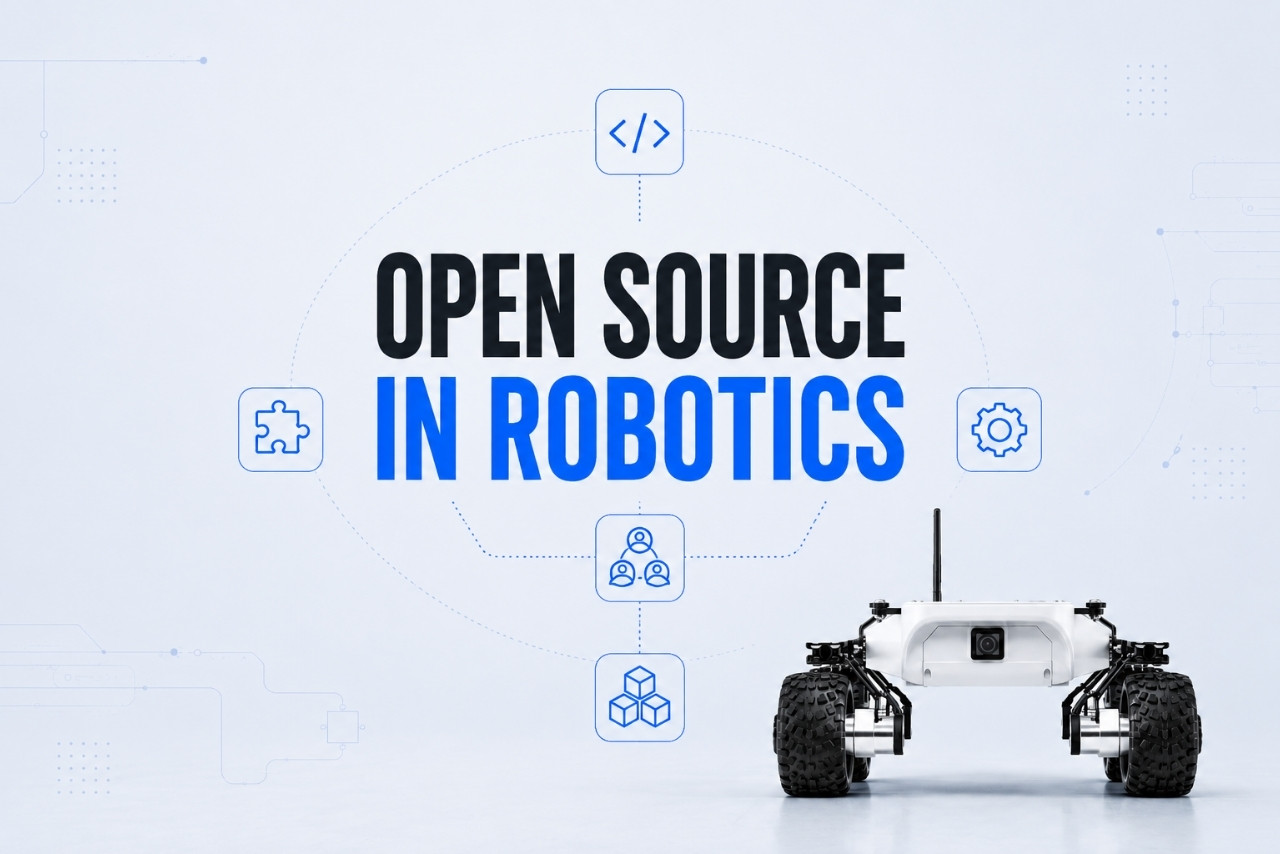
TL;DR: Open source robotics is a working business model, not a charity. Companies like Fictionlab build commercial mobile robot platforms on top of ROS 2, publish hardware designs under open licenses, and earn revenue through hardware sales, integration services, and custom engineering. For the buyer, open source means faster prototyping, reduced vendor lock-in, and access to a global community of contributors. For the vendor, it means lower R&D costs, faster product iteration, and a defensible position based on engineering expertise rather than secrecy. This article explains how the open source robotics business model works, why it scales, and what trade-offs you accept when you choose an open platform like Leo Rover over a closed system.
Why does open source robotics work as a business model?
Open source robotics has stopped being a niche philosophy. The ROS ecosystem — and increasingly ROS 2 — is now the de facto middleware for research and a growing share of industrial deployments. Companies that build on it (and contribute back) are not losing competitive advantage. They are gaining it.
The reason is structural. Robotics is too broad for any single company to solve end to end. A mobile robot needs perception, localization, planning, control, simulation, hardware abstraction, drivers, networking, and safety logic. Building each of these from scratch, in-house, behind a closed license, is economically irrational unless you are a hyperscaler. For everyone else, sharing the boring parts and competing on the hard parts is the better trade.
This is the foundation of Fictionlab’s approach with Leo Rover and Raph Rover: ship hardware that works with ROS 2, publish the firmware, mechanical CAD, and integration code openly, and let the customer extend the platform without asking permission.
What “open source” actually means in a robotics context
The term is overloaded. In robotics, open source can apply to four distinct layers, and vendors rarely open all of them:
- Software stack: middleware (ROS 2), drivers, navigation packages, perception nodes. Licensed under Apache 2.0, BSD, or MIT in most cases.
- Firmware: the code running on microcontrollers handling motor control, IMU data, and low-level safety.
- Electronics: schematics, PCB layouts, and bills of materials for custom boards.
- Mechanical design: CAD files for the chassis, mounts, and 3D-printable parts.
Leo Rover, for example, publishes all four layers. You can fork the firmware, redesign the chassis in Fusion 360, swap the compute unit from a Raspberry Pi to a Jetson, and the manufacturer does not consider that a contract violation. That is unusual in industrial robotics and central to how the platform is used in field research and education.
How does the revenue model work without selling locked software?
If the code is free, where does the money come from? In practice, open source robotics companies earn revenue through four channels:
- Hardware sales: physical robots, spare parts, sensor kits, and accessories. The marginal cost of replicating open source software is zero, but the marginal cost of manufacturing a sealed, IP-rated chassis with calibrated drivetrain is not.
- Custom engineering: adapting the platform to specific use cases, integrating non-standard sensors, or building derivative robots. Fictionlab’s custom robotics service is an example of this model in practice.
- Integration and support: commissioning, training, and long-term maintenance contracts for institutional buyers.
- Manufacturing expertise: turning a reference design into a reliable, field-deployable unit is non-trivial. The CAD is free; the supply chain, QA process, and assembly know-how are not.
This is the same pattern Red Hat used for Linux and HashiCorp historically used for infrastructure tools, adapted to physical goods. The open artifact is a marketing channel and a community engine. The revenue comes from execution.
What you actually get when you buy an open platform
From a robotics engineer’s perspective, the practical differences between an open and a closed platform show up in week two of a project, not week one.
With a closed platform, you typically get a polished SDK, documentation written by a tech writer, and a support ticket queue. With an open platform like Leo Rover, you get the source code, the schematics, a preconfigured ROS 2 stack, and a community forum where the engineers who designed the robot answer questions directly.
The trade-offs are real. Specifically:
- Faster customization: if you need to add a LiDAR not supported out of the box, you write or adapt the driver against the open ROS 2 interfaces. No NDAs, no waiting for a vendor roadmap.
- Reduced vendor lock-in: if Fictionlab ceased operations tomorrow, your Leo Rover fleet would still run. The firmware compiles from public sources, parts are documented, and the ROS 2 ecosystem is independent of any single vendor.
- Higher initial learning curve: you need engineers who can read C++ and Python and are comfortable with Linux. Open platforms assume technical literacy.
- Distributed support: you get answers from a community plus the vendor, not a single SLA-backed channel. For research and education this is usually preferable. For 24/7 production deployment it requires planning.
Why ROS 2 changed the economics
ROS 1 was primarily a research tool. ROS 2, built on DDS (Data Distribution Service), added better support for real-time systems, stronger security primitives, and multi-platform support including microcontrollers via micro-ROS. According to the Open Robotics ROS 2 documentation, the architecture targets production use cases, not just labs.
This matters for the open source robotics business model because it lowered the cost of building a credible commercial product on open foundations. Before ROS 2, a vendor selling an open platform often had to caveat that it was “for research only.” Now, the same stack underpins commercial AMRs, agricultural robots, and inspection UGVs.
For Leo Rover, this means the same software a student uses to learn SLAM in a university lab is the software a field robotics team uses to map a quarry. The platform scales across use cases because the underlying middleware does.
Where open source robotics fits and where it does not
Open source is not universally the right answer. It fits well when:
- You need to customize the robot extensively for a non-standard application.
- You are doing research and need to publish reproducible results.
- You are teaching robotics and need students to see inside every layer.
- You are integrating the robot into a larger system and need predictable interfaces.
- You are deploying in field conditions where remote vendor support is impractical.
It fits less well when you need a turnkey solution with a single throat to choke, a certified safety case out of the box, or a guarantee that nothing in the stack will change for five years. Those requirements push you toward closed industrial systems, and that is a legitimate engineering choice.
How Fictionlab uses the open source model
Fictionlab’s team designs, manufactures, and ships mobile robots from Poland to customers in over 60 countries. The business is built on a simple thesis: open hardware and open software lower the barrier to entry for researchers and engineers, and a meaningful fraction of those users eventually need either more units, custom variants, or integration support. You can read more about the company’s background on the about page.
The Leo Rover platform is used in glaciology fieldwork, agricultural research, university robotics courses, and industrial inspection prototypes. Each of these use cases benefits from the openness in different ways: the glaciologist needs to modify the chassis for cold weather, the university needs source code for teaching, the industrial integrator needs to embed the rover into a larger system without licensing friction.
Frequently Asked Questions
Is open source robotics secure enough for commercial deployment?
ROS 2 includes SROS 2 tooling for authentication, encryption, and access control over DDS communication. Security depends on how the integrator configures the system, not on whether the source is open. Open code is often easier to audit than closed code, which is why many security-conscious organizations prefer it.
What happens to my project if the vendor goes out of business?
With a closed platform, you typically lose support, firmware updates, and sometimes the ability to repair the robot. With an open platform, the source code, schematics, and CAD remain available under their original license. You can manufacture spare parts, recompile firmware, and continue development independently.
Can I use Leo Rover for commercial products, not just research?
Yes. The relevant licenses used by the project should be checked per component, but permissive software licenses such as MIT or Apache 2.0 permit commercial use, and open hardware licenses such as CC BY-SA generally allow building on the design under their terms. Many integrators use Leo Rover as the base platform for derivative commercial robots, often with custom modifications delivered through Fictionlab’s custom robotics service.
How does ROS 2 compare to proprietary robotics middleware?
ROS 2 covers a broader range of hardware and use cases than most proprietary alternatives, and its community is significantly larger. Proprietary middleware can offer tighter integration with specific hardware and clearer support contracts. For most research, education, and prototype work, ROS 2 is the practical default.
Do I need to contribute back if I use open source robotics components?
It depends on the license. Permissive licenses (MIT, Apache 2.0, BSD) do not require you to publish your modifications. Copyleft licenses (GPL, AGPL) may require you to share derivative works under the same license. Most ROS 2 packages use permissive licenses, but you should always check per-package.
What is the realistic learning curve for adopting an open ROS 2 platform?
For an engineer comfortable with Linux and Python or C++, a working teleoperation and basic navigation demo on Leo Rover takes a few hours. Building a custom application with SLAM, perception, and autonomous behavior typically takes weeks to months depending on scope. The open source community shortens this significantly compared to building from scratch.
How do open source robotics companies protect their competitive position?
Through manufacturing expertise, integration know-how, community trust, and speed of iteration. The published artifacts are reproducible in theory but expensive to reproduce in practice. The competitive moat is execution, not secrecy.
Where to go next
If you are evaluating whether an open source mobile robot platform fits your project, or if you need a custom variant built on a proven open base, Fictionlab’s engineering team can help scope the work. Start with the custom robotics page to see how the open source Leo Rover platform is adapted for specific research and industrial applications.